How CollegeFind AI Is Transforming School Counseling with AI
Why School Counselors Need AI More Than Ever
It's 7:40 a.m., and there's already a line outside the counseling office…!!
A senior needs a transcript signed before a deadline that closes tonight…!!
A junior's FAFSA got flagged for verification, and nobody has told the family yet…!!
A parent has emailed twice since Sunday asking why nothing has moved since October. By the time first period starts, this counselor has already made a dozen small decisions that will shape a student's next four years, and they're doing it for a caseload well above what any national body says one person can manage safely.
That scene repeats itself in some form in most public high schools in the country. It's not a staffing failure at any one school. It's a national math problem, and the numbers are public.
The Problem, in the Government's Own Numbers
The American School Counselor Association recommends a 250-to-1 student-to-counselor ratio as the ceiling for a counselor to do the job well, including college guidance, mental health referrals, scheduling, crisis response, and more, all for the same caseload. The most recent national figure, drawn from National Center for Education Statistics data reported through ASCA, puts the real ratio at 372 students for every counselor which is 49% above that recommended ceiling. High schools have actually improved on this front for the first time in years, but elementary and middle schools remain roughly three times more overloaded, which means the strain simply shifts to whichever counselor a student happens to reach in a given year.
Layer the Free Application for Federal Student Aid (FAFSA) process on top of that ratio, and the math gets worse before it gets better. Since the U.S. Department of Education's overhaul of the FAFSA form, verification flags, identity-confirmation holds, and processing delays have routinely landed on counseling offices to resolve and often with no additional staffing is there to absorb the work.
A single verification flag can mean a family stuck in limbo for weeks on financial aid and they need to make a decision by May 1. Multiply that by a caseload of 400 or more, and the FAFSA backlog alone becomes a second full-time job layered onto a role that was already short-staffed.
This is the gap that a year of product testing, school partnerships, and published research has quietly been organized around: not “how do we sell schools an AI tool,” but “what does a counselor actually need lifted off their desk first.”
Building the Answer, One Layer at a Time
The response didn't start with a feature list. It started with the same public data above, a state-by-state, grade-band breakdown of counselor ratios built from ASCA and NCES figures rather than internal claims, because a counselor-first case has to survive scrutiny from the people who already live the problem. That data page functions less like a blog post and more like a living reference, a companion piece, Why the Student-to-Counselor Ratio Matters More Than Ever for U.S. Schools, makes the same case for a broader audience on Medium.
From there, the question became workflow-level..
What does the 7:40 a.m. scene above actually look like task by task?
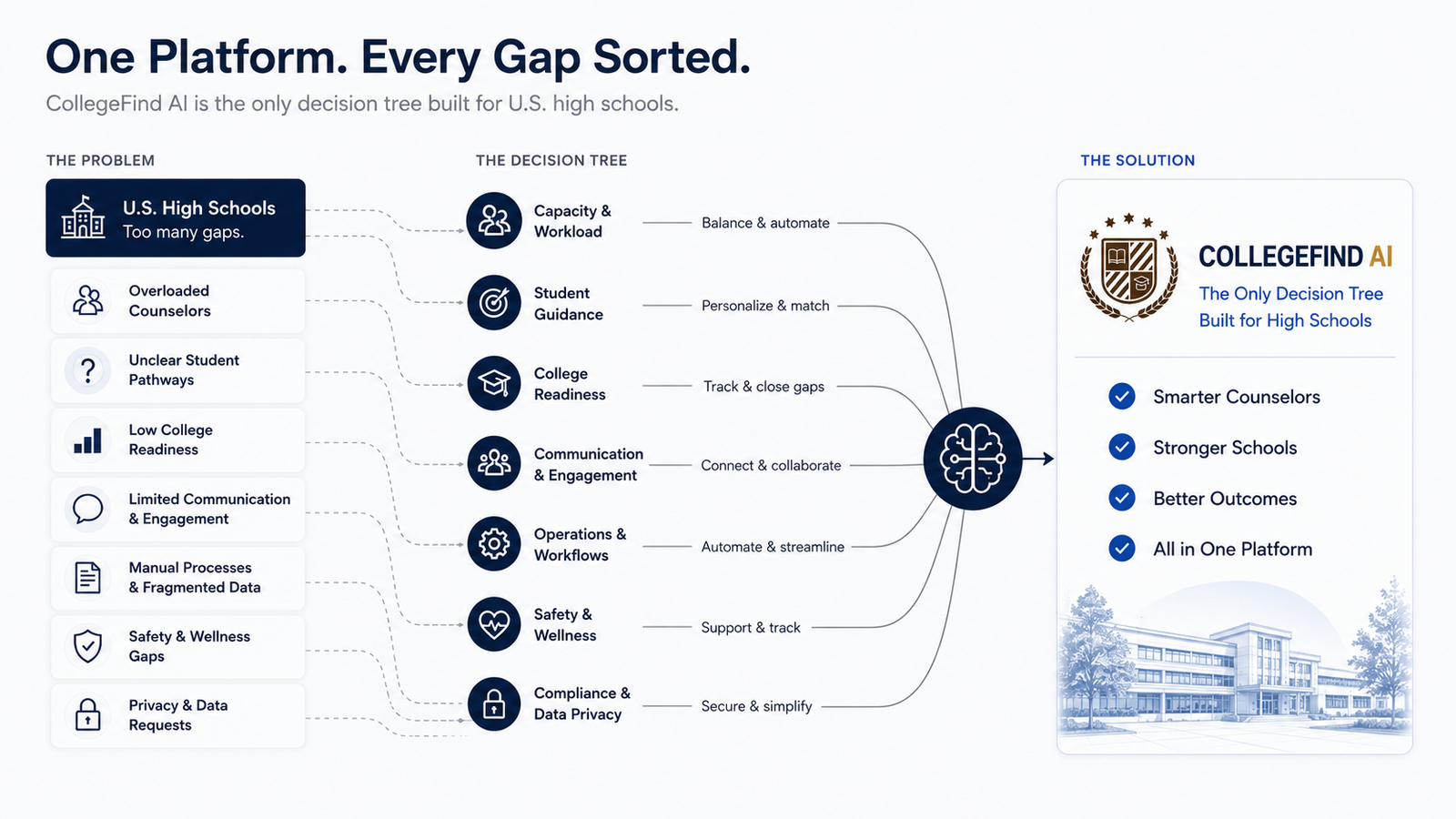
Seven documented AI use cases in the counseling office, where the referral intake, college list generation, application tracking, FAFSA monitoring, parent communication, Individual Graduation Plan (IGP) compliance, and outcome analytics were mapped directly onto the hours counselors report losing every week, detailed further in the three email types that eat two hours of every counselor's week. The FAFSA piece specifically gets its treatment in FAFSA Verification Response Plan: How Schools Can Turn Compliance Into a Student Success Strategy, and the underlying philosophy is summarized bluntly in Stop Pitching AI as a Tool. Start Pitching It as Time Back for Counselors, the goal was never automation for its own sake, but keeping student records organized and readiness milestones visible so a counselor spends more of the day in a room with a student, not a spreadsheet.
None of that matters if a district can't say yes to it. That's why a data privacy and governance guide and an administrative buy-in framework exist like a realistic pilot plan, security posture, and workload case that a counselor can actually carry into a superintendent's office, rather than a vague assurance that “AI is safe.” For staff who are understandably skeptical of any AI pitch in a school setting, AI in School Counseling: A Skeptic's Guide, What It Can and Can't Replace makes this clear and nothing here is designed to replace the relationship between a counselor and a student.
And because every serious buyer eventually asks “designed for counselors, or designed around them,” a direct comparison against tools like Kollegio and CollegeVine was posted previously and in a Medium version for a wider audience, lays out that distinction plainly: tools built around a counselor's actual caseload versus tools built for parents and students that counselors are expected to adopt secondhand.
What “Scale” Actually Means Here
It would be easy to measure progress by schools signed or logos on a page. That misses the real constraint. A counselor's problem was never whether a tool existed; it was their caseload. In a meaningful share of U.S. high schools, that caseload runs past 400 students per counselor, well above even the national 372:1 average and far beyond ASCA's 250:1 ceiling.
Counselor burnout is a capacity issue, not a willpower issue, no amount of individual effort closes a 400:1 gap; only a change in the underlying workload does. So the scale question that actually matters is: how many of those 400-plus students can one counselor support well once referral intake, FAFSA nudging, and readiness tracking stop competing for the same three hours every morning?
That reframes what growth should look like:
- Not a longer feature list.
- Not just more buildings under contract.
- Instead, a narrower gap between a counselor's assigned caseload and the number of students who fall through the cracks before graduation.
The state-by-state ratio pages exist to measure exactly that gap in local terms. A district in Arizona, where ratios run near 570:1, is arguing from a very different starting point than a district in Vermont, closer to 172:1, a national average flattens both into meaninglessness. The same logic applies to counseling ratios in financial aid. The Net Price Calculator vs. Actual Aid Offer: Why the Numbers Never Match breaks its guidance down by state, covering Texas Grant renewal rules, California’s Dream Act aid, New York’s Excelsior residency requirements, Illinois’s early MAP Grant deadline, and Florida's Bright Futures tiers, because a generic national answer doesn't help a counselor sitting across from one specific family.
From One Office to One State
The rollout has followed the data, not the other way around. It starts in a single counseling office, where the highest-friction tasks such as FAFSA tracking, referral intake, and parent email to get tested first are the hours counselors report losing most. It moves to a single district only once a governance case and a workload case can travel together to a superintendent's desk. And it localises state by state after that, with Texas, Florida, California, New York, and Illinois first in line for dedicated ratio breakdowns, each one meant to give a district its own baseline before and after like a standard this work is holding itself to as much as it's asking districts to.
The foundation isn't finished, and it isn't supposed to look finished. It's a data layer built on public ASCA and NCES figures, a workflow layer built around FAFSA and referral realities documented by the U.S. Department of Education's own guidance, a trust layer built for a superintendent's scrutiny, and a positioning layer that says plainly what the product is and isn't for. collegefind.ai carries that foundation forward one state at a time and the Medium archive and X feed will carry each new state release as it publishes, alongside a behind-the-scenes look at the process in The Medium Growth Myth: My 15-Article Experiment.
FAQ
Is the goal to replace school counselors with AI?
No. Every workflow described here, like FAFSA tracking, referral intake, parent communication, is built to free counselor time for direct student contact, not to remove the counselor from the process.
Why lead with state-level counselor ratio data instead of product marketing?
Because the case for AI-assisted counseling capacity has to be made in local terms. A national 372:1 average, drawn from ASCA and NCES figures, means something different in Vermont than it does in Arizona, and districts need that local baseline to evaluate their own staffing gap.
Which states get a dedicated counselor-ratio breakdown first?
Texas, Florida, California, New York, and Illinois are first in line, reflecting where the scale opportunity, like large student populations against uneven counselor staffing, is most immediate.
How is “scale” measured here if not by number of schools?
By the gap between a counselor's actual caseload, often more than 400 students, and the number of students who receive timely follow-up. Progress means narrowing that gap, not adding logos.
Where does the FAFSA verification burden fit into all this?
That burden is one of the specific workflows this foundation was built to absorb first. Since the U.S. Department of Education's FAFSA overhaul, verification flags and processing delays have landed disproportionately on counseling offices with no added staffing.