The 3 Emails That Eat 2 Hours of Every Counselors Week (And How to Reclaim Them)
You open your inbox at 7:43 a.m.
Three student appointments before lunch. A college rep visiting second period. There are somewhere between 40 and 60 unread emails. And right there, spread across the first two screens, are fourteen versions of the same three questions.
Different names. Different students. Same anxiety. Same ask.
If this is your Tuesday morning… or your Monday, Wednesday, Thursday, and Friday morning, you are not alone, and you are not doing anything wrong. You are working inside a system that was built for a caseload that no longer exists.
The national student-to-school counsellor ratio in the United States currently stands at 372:1 for the 2024–25 school year, according to the American School Counsellor Association. ASCA's own recommended ratio is 250:1. In California, which has more public school students than any other state, the ratio is 464:1. In Arizona, the ratio reaches 570:1. In parts of urban Texas and Florida, it is higher still.
At 372 students per counsellor, giving every student one 30-minute college conversation per year would require working every waking hour of a four-week month before a single email was opened. That is, before the parent meetings, the transcript requests, the testing coordination, the 504 plans, and the daily crises that are part of this job, regardless of how many students are in your caseload.
The emails are not going to stop. But the time they take can change significantly, starting today.
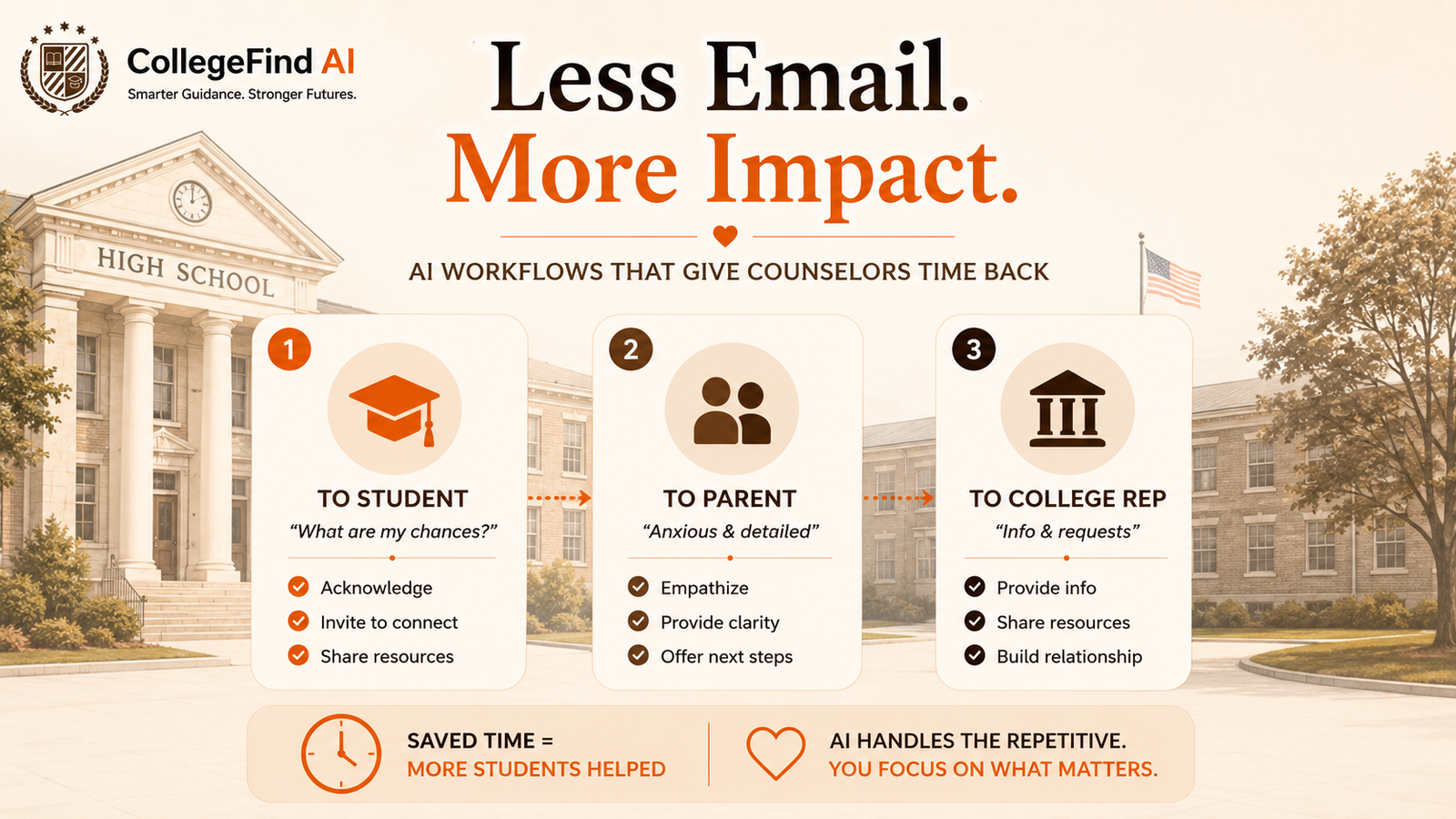
Here are the three email types that take up the most time in a US school counsellor’s week, along with the exact AI prompts to handle them faster without sounding like an automated system.
Email type one: "What are my chances?"
It comes in every shape a teenager can invent.
"Hi, I was wondering if you think I have a good shot at Michigan. GPA is 3.7, SAT was 1340."
"My parents really want me to apply to Georgetown. Honest opinion?"
"Can you look at my list and tell me if my reaches are realistic for someone with my stats?"
None of these is a bad question. They come from real anxiety, from students in California, Texas, New York, and Georgia, who trust you enough to ask the one adult in their school who actually knows how the process works. The problem is answering them properly and drawing on your knowledge of this specific student's full profile, the school's admission trends for students from your district, the quality of their essay, their demonstrated interest, and their financial situation. It takes ten to fifteen minutes, which you do not have at 9:47 p.m. when the email arrives.
And making a casual prediction in an email is a liability you do not need.
AI will not replace your judgement here. It should not. But it can help you respond within the hour in a way that feels human, gives you time for the real conversation, and closes the loop without committing to anything you cannot deliver.
Use this prompt in ChatGPT, Claude, or Gemini:
Draft a warm, professional response to a high school student asking whether their academic profile makes them a competitive candidate for [University Name].
Tone: caring and honest. Do not give a yes/no answer via email. Acknowledge their question genuinely. Invite them to book a 15-minute check-in so we can review their full profile together. Point them to a college list resource in the meantime.
Under 150 words.
Sign off as [Your Name],
School Counselor at [School Name].
Takes 45 seconds to run. It takes two minutes to personalise and edit the list. The student feels heard, has a concrete next step, and the conversation moves where it should be, in your office, where your actual expertise applies.
For a comprehensive framework on creating resilient college lists, see “What a Good College List Actually Looks Like at 300+ Students”.
Email type two: The 10:47 p.m. parent message
"I've been reading that acceptance rates at top schools have dropped again this year. Should my daughter be applying to more schools?
Are we behind?
What should we be doing right now?"
These arrive on Sunday nights, before holiday breaks, the morning after a news story about Yale's acceptance rate drops to 3.7%. They come from a place of genuine fear. Parents in New Jersey suburbs, Houston, and rural Ohio navigate a system that has changed dramatically even since they applied themselves. They are not trying to make your life harder. They just have nobody else to ask.
But here is the compound problem: a rushed or vague reply generates three more questions by Tuesday. Every imprecise answer is an investment in future email threads you will have to manage.
The goal is not just to respond faster. It is to respond in a way that makes the next step clear.
Use this prompt:
Draft a 200-word email to an anxious parent asking whether their child is behind in the college application process. The student is currently in [Grade]. It is [Month].
Tone: calm, knowledgeable, reassuring, but never dismissive of their concern. Include exactly one concrete next step the family can take this week. Do not make promises about specific outcomes or schools. End by pointing them to our next counselor office hours or appointment availability.
The phrase "exactly one concrete next step" is doing the most important work in that prompt. A parent who has something specific to do is a parent who is significantly less likely to send a follow-up email at midnight asking what they should do.
We saw this same dynamic across our analysis of what separates families who navigate the process smoothly from those who spiral into anxiety and poor decisions. For more depth, read the full breakdown in What We Learned From 10,000 Student College Lists: 3 Patterns That Predict Admission Success on Medium.
Email type three: The deadline reminder that never ends
A student misses your first reminder…!
You follow up.
They say they saw it…!!!
They miss the next deadline.
You follow up again.
They ask what the deadline actually is.
You send it again.
They ask about the fee waiver.
You sent that link.
Three weeks later, they ask if you have already submitted their school report.
Multiply this by 80 students in active application mode in October and November, the two months when US school counsellors' inboxes peak, and you have a second full-time job embedded in your already impossible one.
The fix is not to chase more aggressively. It is building a sequence once and deploying it to everyone.
Use this prompt:
Create a 4-email deadline reminder sequence for US high school seniors in active college application mode. Send at: 6 weeks before deadline, 3 weeks before, 1 week before, and 48 hours before. Each email: under 100 words, states the specific deadline clearly and what the student needs to submit, includes placeholder links for [Application Portal URL] and [Fee Waiver Information], uses a warm but direct tone appropriate for a 17–18 year old. Written from their school counselor, not from an automated system. Do not use the word "reminder" in the subject line of any email, write subject lines students will actually open.
Build this sequence once for each application cycle. Deploy it to every student, with five minutes of light personalisation for each. The October and November chasing time, for counsellors in California managing 464 students, in Texas managing 400+, and in New York City public schools managing 500+, compresses from hours per week to minutes.
For the wider picture on what happens to student outcomes when administrative work crowds out real counselling time, this piece from our Medium profile puts it plainly: The 415:1 Student-to-Counsellor Ratio: What It Means for Every U.S. High School Student.
What AI cannot do and why that matters
AI can draft… It cannot know your student.
It cannot sense that Jordan's “what are my chances?” email is really about his father, who went to Michigan and whom he is terrified of disappointing.
It cannot read the subtext in a parent email and decide whether this family needs additional information or just needs to feel heard by a human being who remembers their child's name.
The counsellors who benefit most from AI use it strategically rather than frequently. They are the ones who use it most precisely on the work that is genuinely interchangeable, so they have something left for the work that is not.
As we explored in AI Won't Replace College Counsellors. It will expose what students actually need; the case for AI in US school counselling is not efficiency for its own sake. It is giving every student, regardless of their zip code, access to a counsellor who actually has enough time for them.
Try it in five minutes: no training required
Pick the one email type above that takes the most of your time right now.
Copy the prompt exactly.
Paste it into any free AI tool like ChatGPT, Gemini, or Claude.
Add two or three lines of context about your school, your student, and your situation.
Edit the draft, which will take about two minutes even if the draft is imperfect.
Do this ten times, and you will have a precise sense of what AI can and cannot do in your specific workflow. Most counsellors who try it find that editing an AI draft takes about 20% of the time that writing from scratch does.
Twenty per cent. Across a week of 50 emails. That was hours back in a week where hours do not exist to spare.
Want to see these prompts live, with real examples, real counsellor questions, and the ethical framework that makes AI use responsible in a school counselling context?
Follow CollegeFind AI for weekly resources designed for US school counsellors.
Medium
X / Twitter
LinkedIn