Building Administrative Buy-In for AI Adoption in School Counseling
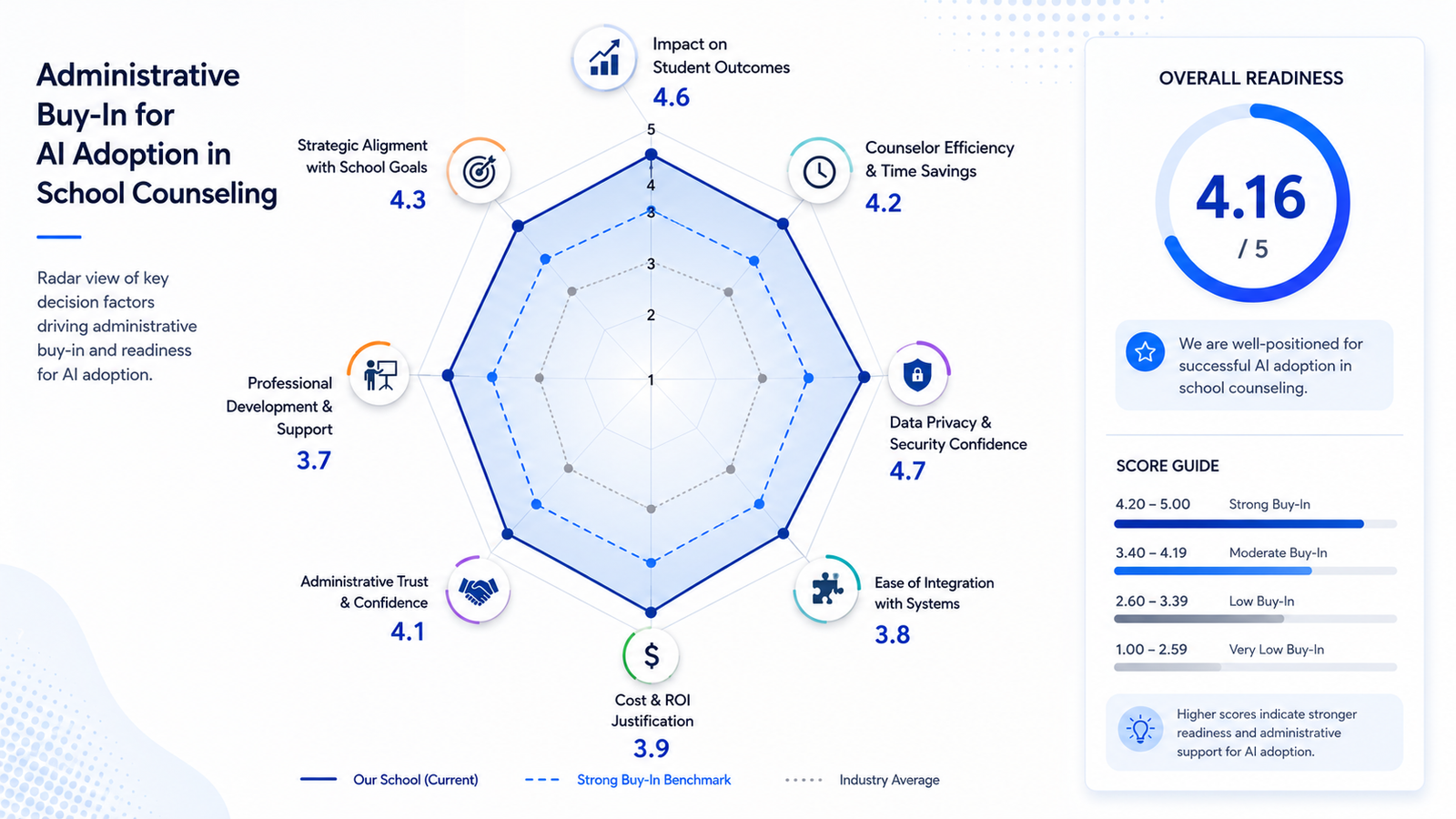
If you've been considering bringing AI into your counseling office, the hardest part usually isn't picking a tool. It's getting your administrator to say yes.
The good news is that this conversation doesn't have to be difficult. Counselors aren't short on reasons to want help; rather, they're short on time. The national student-to-school-counselor ratio sat at 372:1 in the 2024–25 school year, still well above the American School Counselor Association's recommended 250:1. That gap isn't just a statistic, but the research on counselor caseloads shows it's directly linked to higher burnout and lower job satisfaction, which is why so many counselors are stretched across scheduling, crisis response, college advising, and paperwork, with little room left for the one-on-one work that matters most.
The way to bring AI into that conversation is to stop treating it like a new piece of technology and start treating it like a plan to protect counselor time. Here's how to make that case step-by-step and be ready for your admin’s first question about data and privacy.
Start With the Problem, Not the Tool
Admins don't approve technology for its own sake. They approve solutions to problems they already recognize. So the opening of this conversation shouldn't be
"I want to try an AI tool."
It should be a statement about workload.
Something like:
"We're not asking to adopt AI for the sake of innovation. We're asking to reduce low-value administrative work so counselors can spend more time with students."
That framing does three things at once. It signals discipline instead of novelty-chasing. It ties directly to student access, which is a metric every admin already tracks. And it heads off the assumption that AI is being pitched as a replacement for counselor judgment, rather than a way to protect it, a distinction professional counseling guidance treats as essential to responsible AI adoption.
Use Current Data to Build Your Case
Vague appeals rarely move a budget conversation. Specific numbers do.
Lead with the ratio. ASCA reports the national average improved slightly from 376:1 to 372:1 between 2023–24 and 2024–25, which is a roughly 1% gain that translated into about 529,080 more students gaining access to a counselor. That's real progress, but it still leaves the average school far from the 250:1 benchmark ASCA recommends.
Pair that with the human cost, which includes research covering 327 school counselors that found larger caseloads were consistently linked to higher burnout, higher job stress, and lower job satisfaction. That's the piece that makes the issue a capacity conversation rather than a technology conversation. That every hour AI can take off a counselor's plate is an hour that goes back toward the ratio problem, not away from it.
If you're building a fuller case with data and messaging like this, the AI-Assisted Counselor's Playbook walks through the numbers in more depth and gives you ready-to-use talking points for exactly this kind of pitch.
Show What AI Can Actually Do
Once you frame the problem, admins will want specifics. Keep the list narrow and low-risk on purpose, as this isn't about handing decisions to a model; it's about clearing out repetitive work:
- Drafting routine parent or student emails
- Creating first-pass notes or summaries after meetings
- Organizing follow-up workflows and reminders
- Generating lesson-plan ideas for classroom guidance lessons
- Producing an initial draft of an intervention plan for a counselor to review and finalize
ASCA itself has pointed to these kinds of education-focused AI use cases and the communication support, lesson planning, and intervention drafting as reasonable starting points. The throughline in all of them is that a human counselor reviews and approves the output before it goes anywhere. For a broader look at where such technology is already working in practice, our piece on AI use cases in the high school counseling office covers real examples counselors are using today.
AI Security and Privacy
This is usually where the conversation actually gets decided, so don't wait for your admin to raise it; instead, bring it up yourself.
Before any tool touches a counseling workflow, be ready to answer four questions:
What data does this tool collect?
Where is it stored?
Who can access it?
And has it been approved by the district?
Guidance on AI in schools consistently comes back to these same fundamentals, such as data minimization, clear governance, and human oversight of anything the tool produces.
The practical rule for counseling offices is simple: no IEPs, discipline records, mental health notes, or other sensitive student data should ever go into a public or unapproved AI tool. School privacy guidance recommends sticking to low-risk, low-sensitivity tasks unless a tool has gone through formal district review, and ed-tech privacy resources point to the importance of real access controls, encryption, and a clear breach protocol behind whatever you use.
A line that tends to land well with administrators:
"We should only use AI in the counseling office if we can clearly define what data the tool sees, confirm it's approved by the district, and make sure no sensitive student information is exposed."
Leading with that sentence — rather than waiting to be asked — is often what separates a proposal that gets approved from one that gets tabled.
Offer a Small Pilot, Not a Big Leap
Nobody wants to approve a sweeping change to how a counseling office operates.
A pilot is a much easier…YES.
Keep it tight with only one counseling team, one or two repetitive workflows, a defined trial window, and a short, explicit list of what AI is and isn't allowed to do. At the end of the trial, measure something concrete, for instance, time saved, fewer emails backed up, and faster turnaround on notes, and bring that back to the table.
This approach works because it gives your admin something to evaluate rather than something to take on faith. In a school environment where policy, privacy, and workload concerns all overlap, "let's try this narrowly and measure it" is a far easier decision than "let's adopt this broadly."
Use a Script That Sounds Strategic
When you sit down for the actual conversation, a handful of short, outcome-focused lines will carry most of the weight:
- We need to reduce repetitive tasks so counselors can spend more time with students.
- AI can help draft, organize, and streamline low-risk workflows.
- Counselors will still review everything before it's shared.
- Privacy and district approval will set the boundaries.
- The goal is more capacity, not less human judgment.
Notice that none of these mentions a specific product. That's deliberate. This script functions as a workload plan rather than a technology pitch, and it directly addresses the counselor-burnout research by linking the request to caseload pressure.
What Success Should Look Like
Define success before the pilot starts, not after.
Reasonable markers include measurable time saved on routine communication, faster turnaround on notes and summaries, no privacy or data incidents, and counselors reporting that the tool actually reduced friction rather than added a new task to manage.
If those markers are met, you have a data-backed case for expanding the pilot and a template for how the next AI conversation with your admin goes, too.
Final Takeaway for School Leaders
The strongest case for AI in the counseling office isn't that it's new. It's that it protects counselor time in a system that's already under strain. With a 372:1 national ratio, a 250:1 recommendation still out of reach, and clear evidence tying heavier caseloads to burnout, AI stops being a trend conversation and becomes a capacity conversation, which is precisely the conversation most administrators are already trying to have.
This Conversation Looks a Little Different by State
District policy and privacy rules on AI vary enough by state that it's worth tailoring the pitch to where you sit:
- Texas counselors should lead with the district’s data governance policy, since many Texas ISDs already require formal AI-tool review before classroom or office use.
- Florida counselors should be ready to reference state guidance on student data privacy, which tends to be stricter about third-party data sharing.
- California district leaders will likely expect the privacy section of this pitch to reference CCPA/CPRA-aligned data handling, given the state's broader consumer privacy law.
- New York counseling offices should anchor the pilot proposal in existing ed-tech vendor approval workflows, which many NY districts already have in place for other software tools.
The core script covers the problem first, data second, privacy third, and a small pilot that holds everywhere fourth. What changes from state to state is the policy language and approval process referenced in the privacy section.
FAQ
Is it safe to use AI with student data?
Only for low-risk, non-sensitive tasks, and only with tools your district has formally reviewed and approved. Sensitive records such as IEPs, discipline history, and mental health notes shouldn't go into any AI tool without explicit district sign-off.
What's the easiest way to get admin buy-in?
Start with a small, defined pilot rather than asking for a full rollout. One team, one or two workflows, a short trial, and a clear measurement plan.
What tasks are a particularly strong fit for AI in a counseling office?
Routine emails, meeting notes, follow-up organization, lesson-plan brainstorming, and first-draft intervention plans, all reviewed by a counselor before use.
Does AI replace counselor judgment?
No, every use case here assumes a counselor reviews and approves the output. AI is positioned to reduce administrative load, not to make decisions on a counselor's behalf.