7 AI Use Cases in the High School Counseling Office (With Workflow Examples)
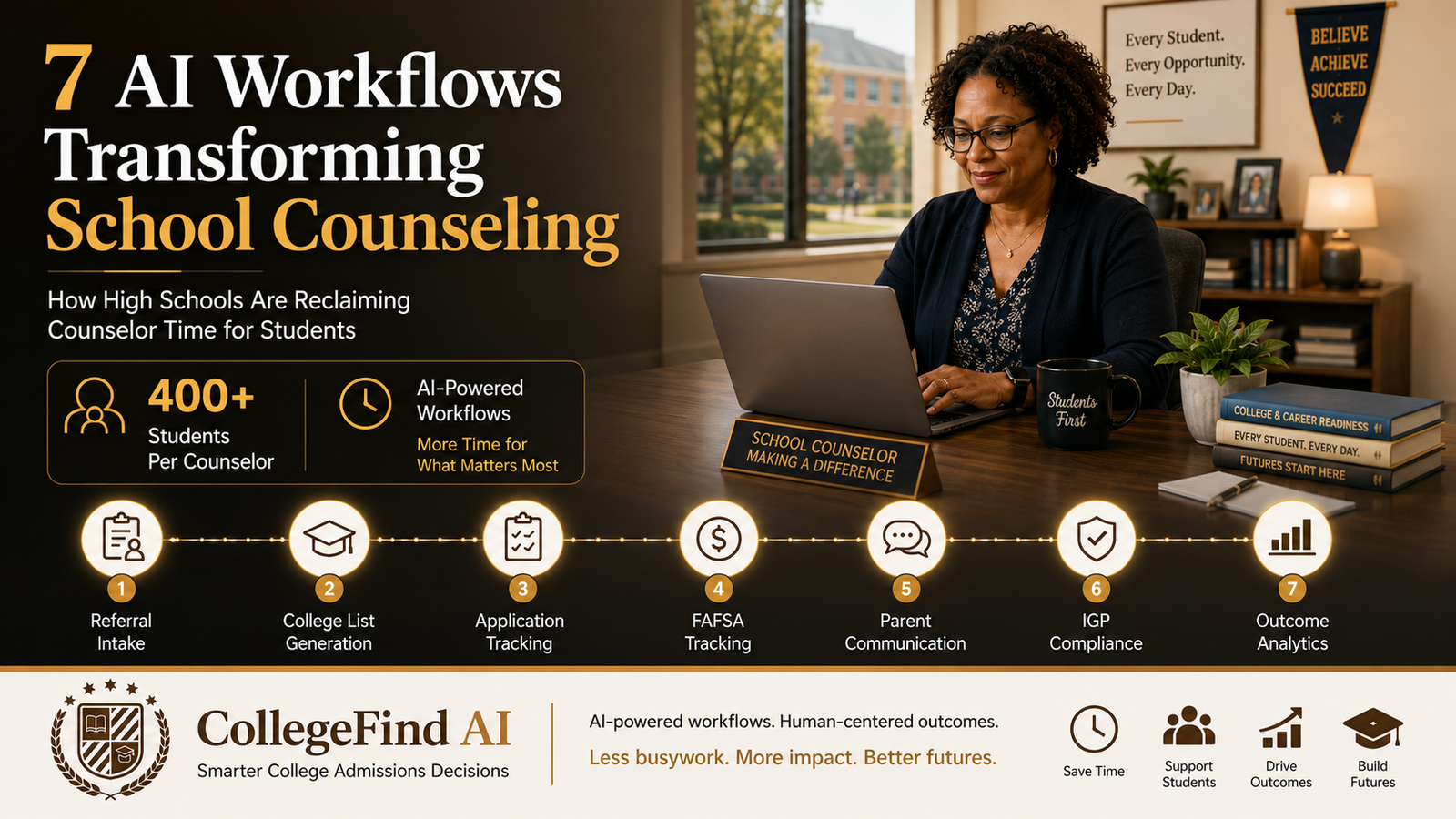
7 AI Use Cases in the High School Counselling Office
With Workflow Examples
Published by CollegeFind.ai on Medium · June 2026
US high school counsellors are working at the limits of their capacity.
Nationally, public high school counsellors serve an average of over 400 students each, far exceeding the 250:1 ratio recommended by the American School Counsellor Association. At the same time, they are expected to deliver the following:
- Academic and social–emotional support
- Individual Graduation Plan (IGP) compliance
- College and career advising
- FAFSA completion and postsecondary transitions
In that environment, the core question most principals and district leaders ask is not “Can AI help?” but rather “What does AI actually do in a counselling office, and what does it look like in practice?”
This post answers that question with seven concrete, data-driven use cases, each illustrated with an end-to-end workflow that can be implemented in a typical US high school or district environment. The focus is operational: where AI fits into the process, what changes for counsellors, and what value it creates for students. Tools like CollegeFind.ai are built around exactly this model, which reduces administrative overhead and allows counsellors to spend more time on students.
Use Case 1: Student Referral Intake and Centralised Record Creation
The problem: fragmented signals, delayed support
Information about at-risk students arrives from multiple uncoordinated channels:
- Teacher emails and gradebook flags
- Parent phone calls and voicemails
- Student self-referral forms
- Administrator discipline or wellness notes
None of these inputs is inherently connected. Before a counsellor can act, they typically spend 5–10 minutes reconstructing context from inboxes, student information systems (SIS), and paper notes that should already be unified. At scale, with 400+ students per counsellor, this friction compounds into missed signals and slower interventions.
The AI workflow
Unified intake pipeline:
All referral sources, like web forms, email triggers, SMS, and call logs, feed into a single intake pipeline. Text from emails, form fields, and notes is normalised into a standard structure.
Automated student matching and record aggregation:
AI matches each referral to the correct student profile (even with minor spelling differences) and appends it to a chronological case record that includes attendance, grades, behaviour incidents, and prior interventions.
Risk and urgency classification:
Natural language processing models identify language associated with safety concerns (self-harm, threats, harassment) and high-urgency situations. We promptly escalate these to the appropriate counsellor or administrator, providing them with the full context.
Context-rich counsellor view:
When the counsellor opens a case, they see a single, structured timeline of all relevant events and communications, rather than having to piece together information from different systems.
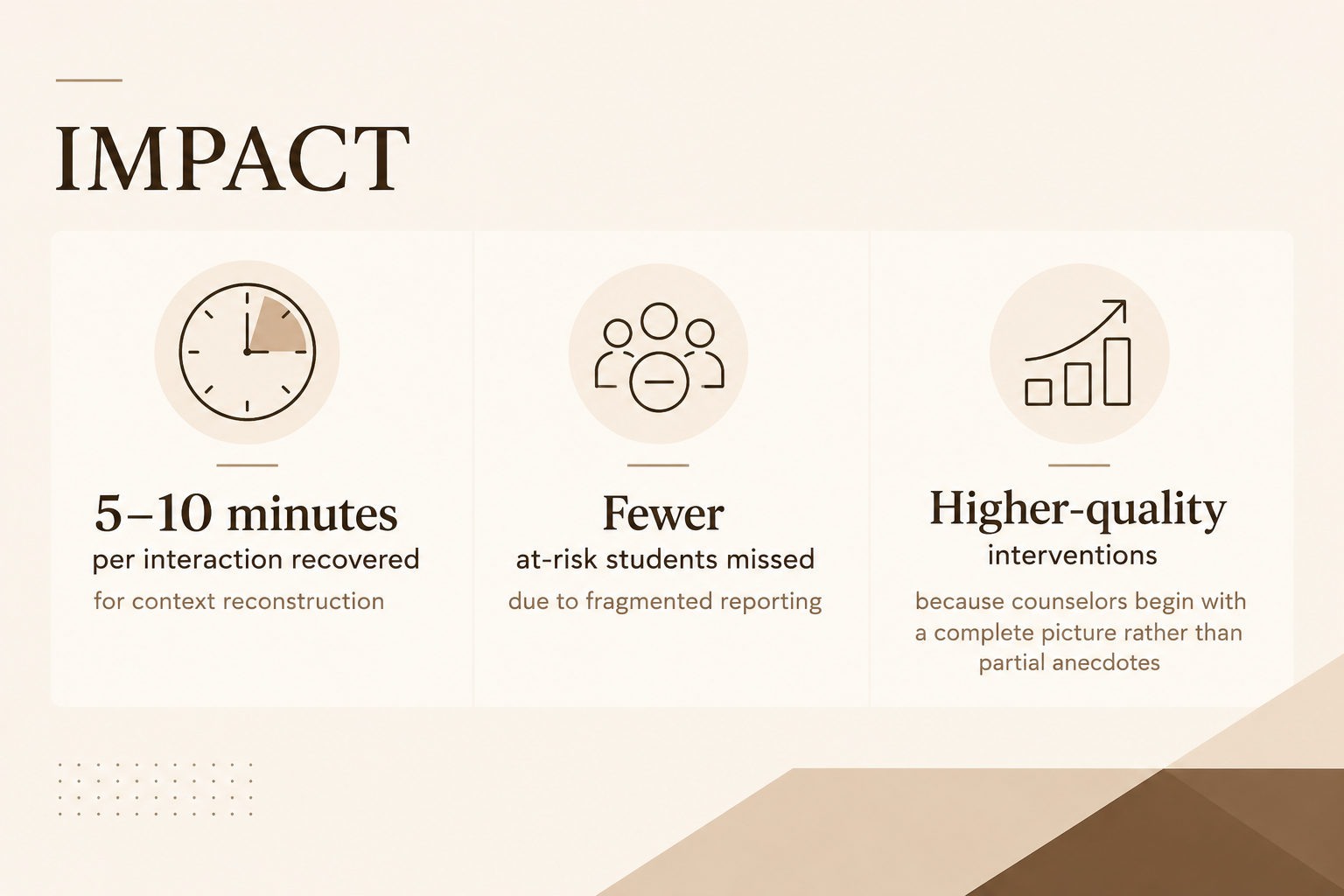
In practical terms, for a counsellor handling 15–20 referrals per week, this can return 1.5–3 hours directly to student-facing work.
Use Case 2: Data-Driven College List Generation
The problem: 415 students per counselor, limited time per junior
In many US high schools, especially in large districts, counsellors manage caseloads of 350 to 450 students. For juniors, building a thoughtful college list requires:
- Pulling academic data (GPA trends, course rigor, test scores)
- Understanding financial constraints and Pell-eligibility
- Capturing geographic and campus-type preferences
- Cross-referencing all of the above against admissions and financial aid data for hundreds of institutions
At current ratios, delivering that level of personalisation for each junior is structurally impossible if done manually.
The AI workflow
Automatic SIS data ingestion:
The SIS automatically ingests academic history, GPA, course rigour, and (where applicable) test scores with no manual re-entry.
Constraint capture and preference mapping:
Short, structured intake forms capture key constraints (e.g., “must be under $X net price”, “within 4 hours’ drive”, “HBCU interest”, and “test-optional only”) along with high-level preferences.
Cross-reference with Common Data Set and admissions data:
AI models compare each student’s profile to acceptance patterns and common data set metrics at hundreds of institutions at once, including admit rates, mid-50th percentile scores, average GPAs, percentage of Pell-eligible students, and more.
Reach → match → safety list generation.
Within seconds, the system generates a preliminary list of reach, match, and safety institutions aligned with the student’s profile and constraints.
Counsellor refinement:
Counsellors review and adjust the list based on qualitative factors that algorithms cannot fully capture, including family context, cultural fit, campus support, undocumented status considerations, and local knowledge of institutional behaviour.
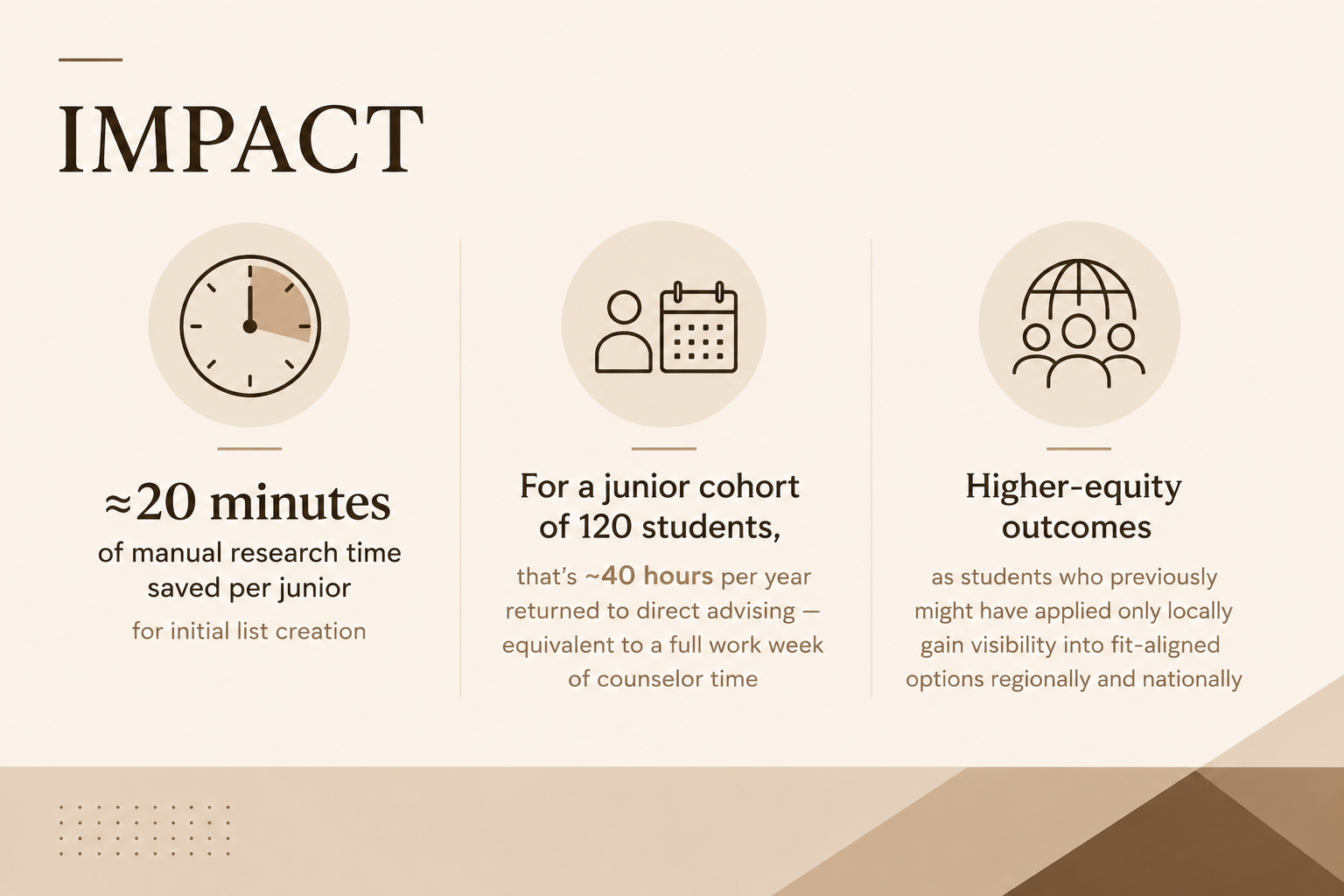
Platforms like CollegeFind.ai operationalise this pattern by combining SIS integration with admissions data to produce counsellor-ready shortlists while still leaving final judgement in human hands. Follow @Collegefindai on X for the latest updates on how this workflow is evolving.
Use Case 3: Application Milestone Tracking and Deadline Nudges
The problem: hundreds of deadlines, one counselor
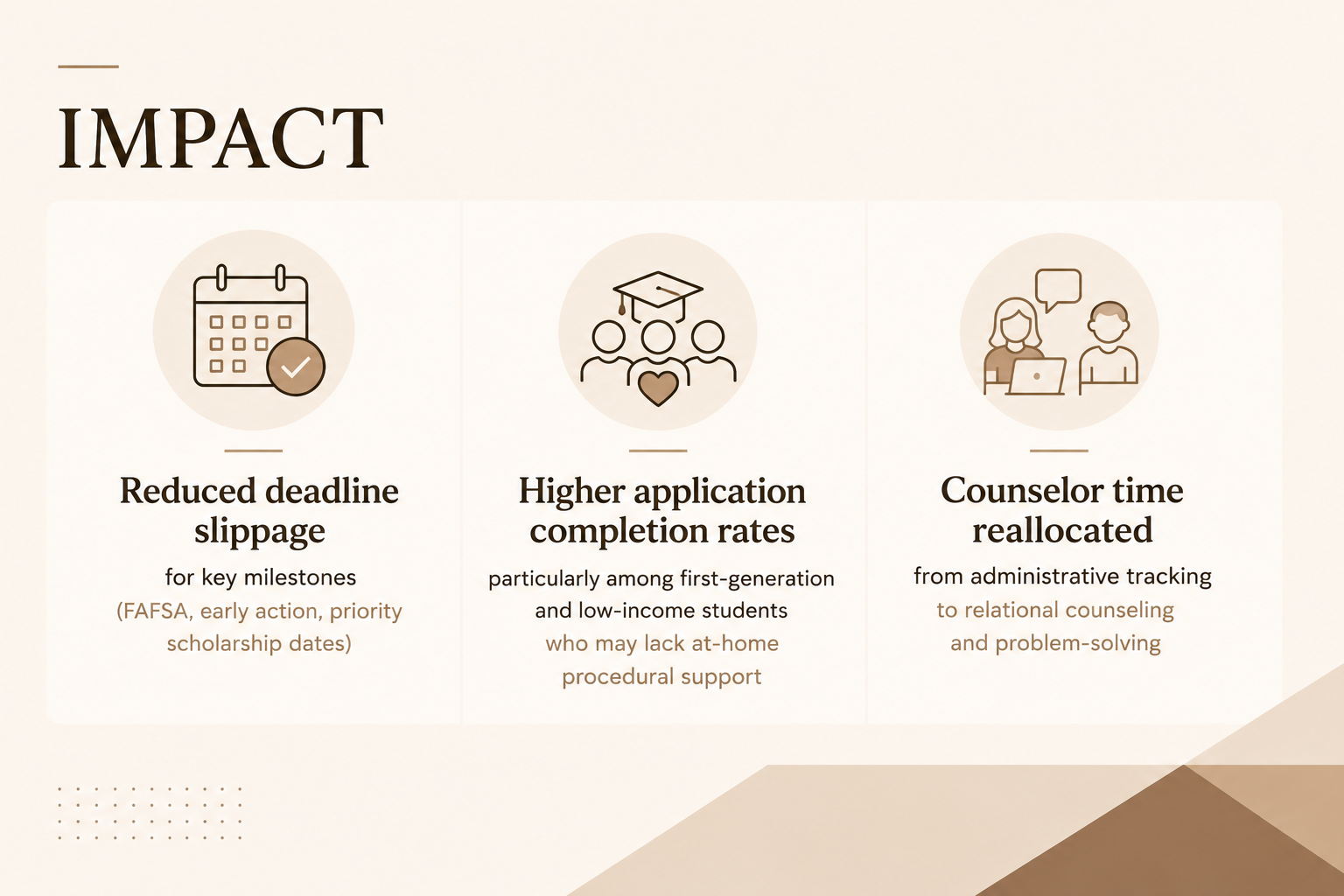
Consider a typical mid-sized US high school: 225 seniors, each applying to 6–10 colleges, with different deadlines for applications, essays, recommendations, test scores, and financial aid forms. The situation quickly becomes a complex web of deadlines and requirements. Manual tracking through spreadsheets, sticky notes, and individual reminders is not sustainable.
The AI workflow
Real-time status monitoring:
The system ingests status data from application platforms (where available), local logs (e.g., recommendation requests), and FAFSA completion feeds to maintain a live view of each student’s progression.
Personalised, specific nudges:
Instead of generic reminders, students receive context-aware prompts such as “You have not yet requested your recommendation from Ms Torres. Her letter for Northwestern is due in 14 days.” Messages can be delivered via email, SMS, app notifications, or school messaging systems.
Exception-based dashboards for counsellors:
Counsellors see a dashboard highlighting only students who are at risk of missing key milestones where no transcripts have been sent, FAFSA has not been started, or zero applications have been submitted.
Targeted human outreach:
Instead of mass reminders, counsellors focus their energy on students who need human intervention such as first-gen students, those with complex family situations, or those who are disengaged.
Use Case 4: FAFSA Completion Nudging and Tracking
The problem: FAFSA as a gating factor for postsecondary access
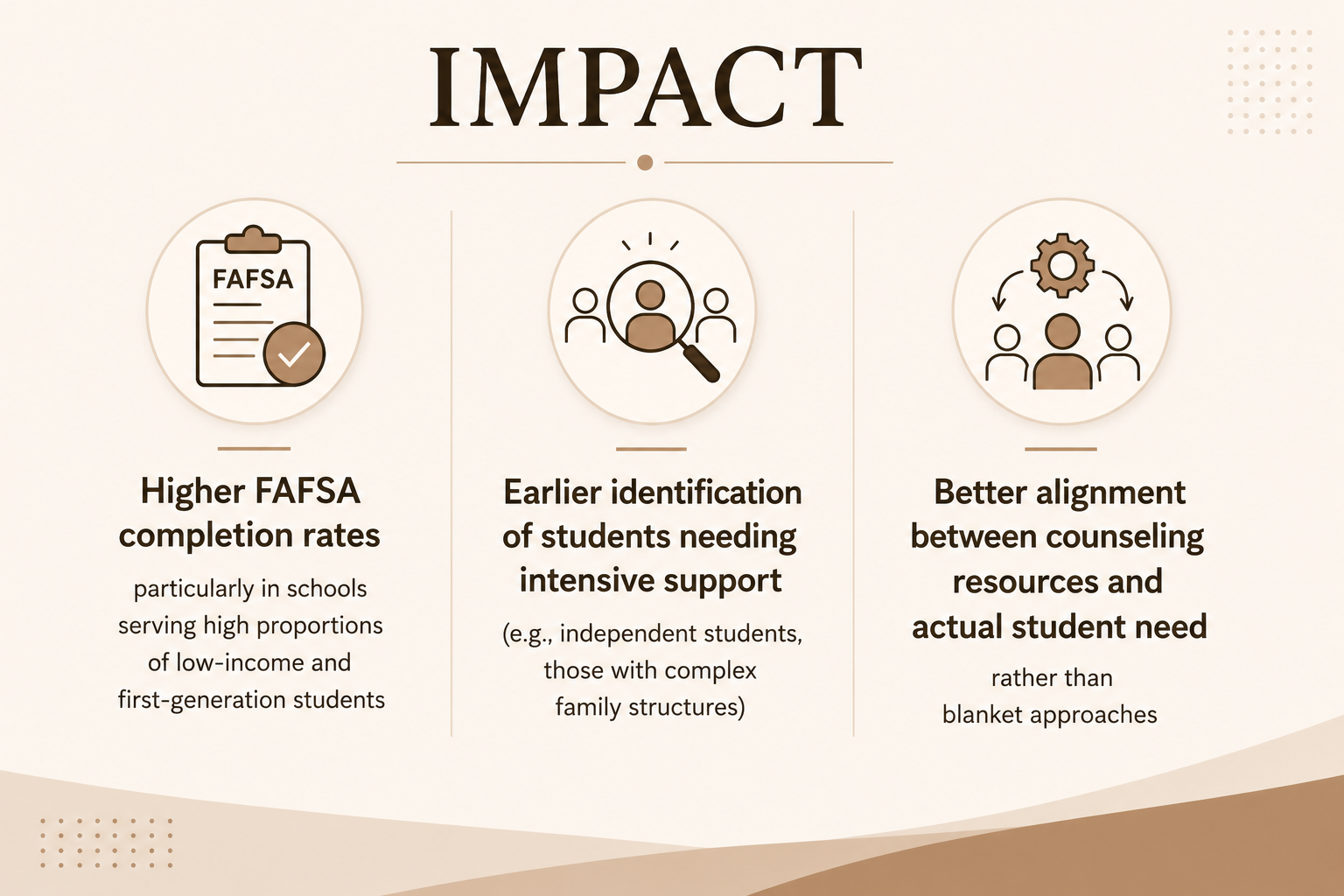
FAFSA completion is one of the strongest predictors of immediate college enrolment, especially for low-income students. Yet completion rates vary widely by district, and counsellors often lack timely, student-level visibility into who has not started, who has started but stalled, who has submitted with errors, or who has successfully completed the form.
The AI workflow
Weekly status updates are ingested from state or federal feeds:
Student-level FAFSA completion data is ingested weekly (where state data sharing allows), mapping status codes to individual students in the SIS.
Segmented messaging by status:
Students and families receive different communications depending on where they are in the process, like from “Here’s why FAFSA matters” for those who haven’t started to “Your FAFSA needs correction” for those who submitted with errors.
Multilingual, culturally responsive outreach:
Messages are delivered in the family’s primary language (e.g., Spanish, Chinese, Arabic, Haitian Creole, or Bengali), reducing information friction and signalling inclusion.
Counsellor visibility of support needs:
Dashboards highlight students who have not started or have stalled, allowing counsellors to proactively schedule FAFSA nights, small-group sessions, or one-on-one appointments before deadlines. CollegeFind.ai provides this kind of visibility for counsellors as part of its core platform.
Use Case 5: After-Hours Parent Communication
The problem: parent questions don’t stop at 3 p.m.
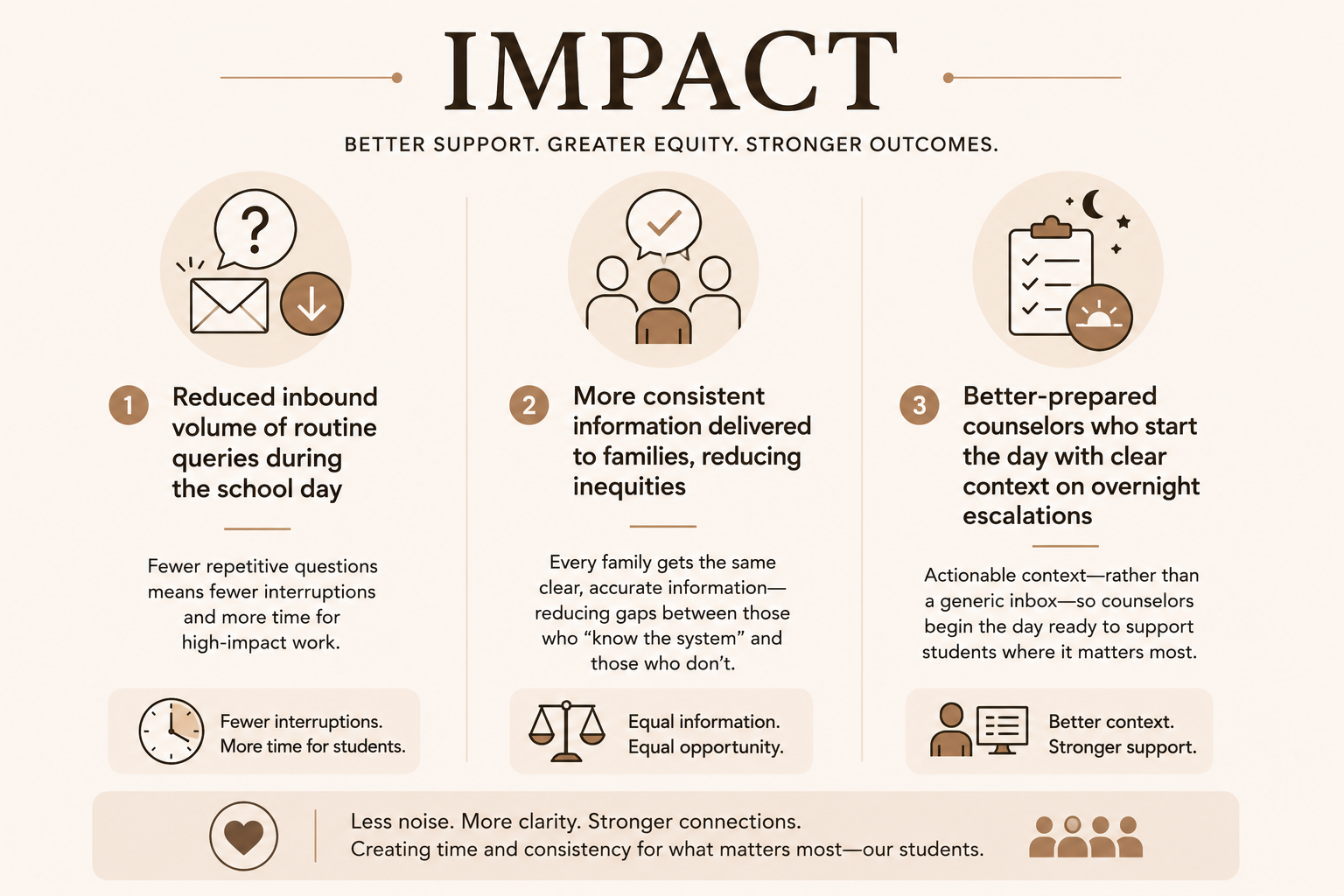
In many communities, parents and carers can only engage with school during evenings or weekends. Counsellors, however, are bound by school hours and capacity. As a result, routine questions go unanswered or are answered inconsistently, high-stakes misunderstandings can derail plans, and counsellors start each day with a backlog of voicemails and emails.
The AI workflow
Training on local context:
The assistant is trained on school-specific counselling policies, graduation requirements, local scholarship information, and up-to-date admissions data for commonly applied institutions.
24/7 handling of routine queries:
Parents can ask questions at any hour via web chat, SMS, or a mobile interface: what credits are needed to graduate, what deadlines apply, and whether the ACT is required at a given school. The assistant provides accurate, consistent answers that align with the guidance of the counsellor.
Automatic interaction logs:
Every interaction is logged and attached to the relevant student’s profile, creating an auditable trail and giving counsellors visibility of family concerns.
Automatic escalation with context:
When questions exceed the assistant’s scope, like legal issues, complex financial aid scenarios, or mental health crises, the system flags them and routes them to the appropriate counsellor with a summary of the conversation.
Use Case 6: IGP Monitoring and Compliance Tracking
The problem: IGP as compliance burden instead of planning tool
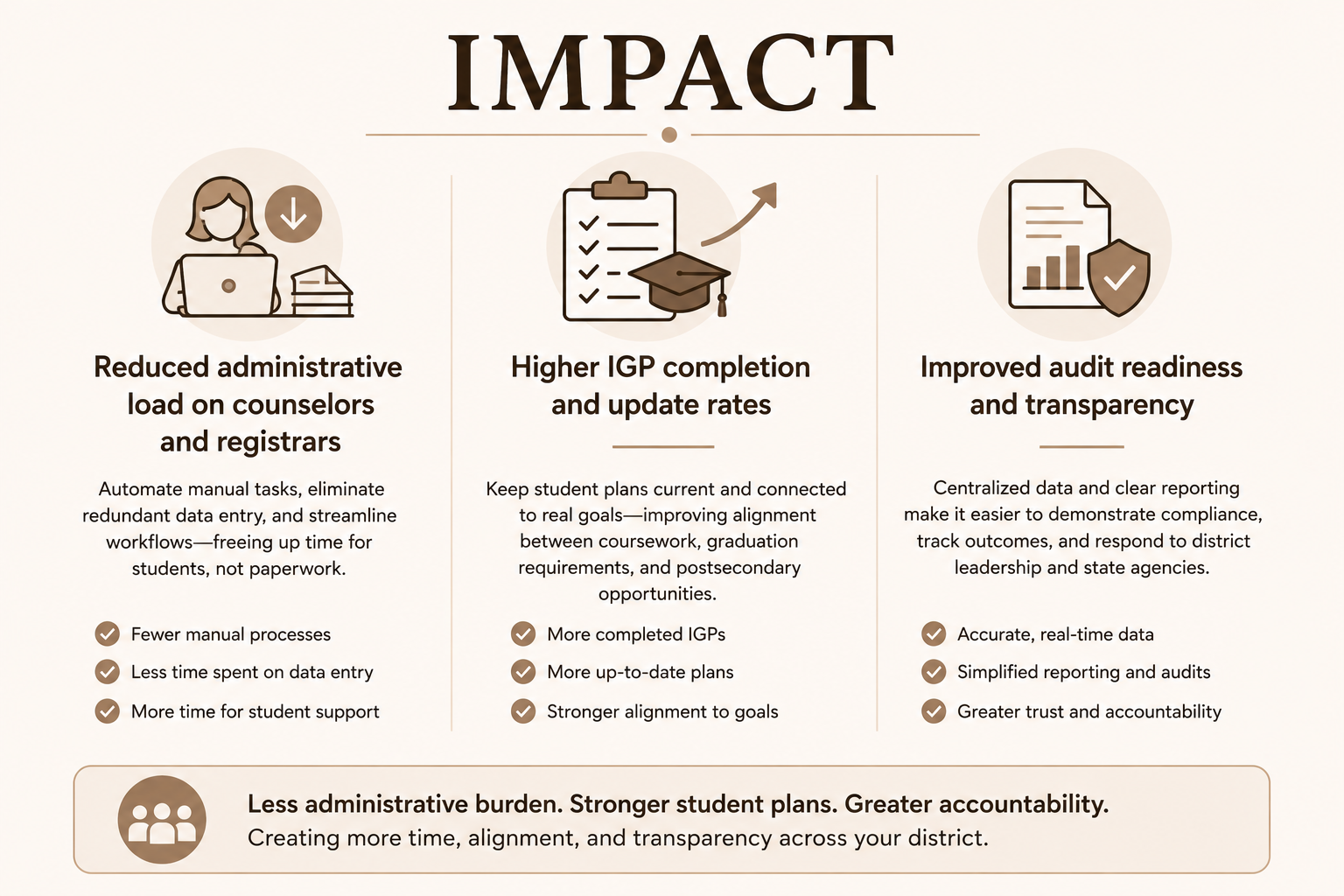
Many states require Individual Graduation Plans (IGPs) or similar documents for every student. In practice, the process often becomes a compliance exercise: paper or PDF forms completed sporadically, manual tracking, and time-consuming reporting for district or state audits. For counsellors already overburdened, such paperwork often displaces more meaningful planning and advising.
The AI workflow
Continuous IGP status monitoring:
Integrated with the SIS, the system monitors IGP completion status for every student, including last updated date, alignment with state requirements, and signature status.
Automated flagging and reminders:
Students whose IGPs are incomplete, misaligned, or approaching review deadlines are automatically flagged. Students and families receive reminders to schedule IGP meetings or update plans.
On-demand compliance reporting:
For district administrators, the system generates up-to-date reports on IGP completion rates by school, grade, and subgroup without requiring manual compilation. Learn more about how CollegeFind.ai is working with districts on compliance workflow improvements.
Use Case 7: Outcome Analytics and District Reporting
The problem: delayed, static visibility into postsecondary outcomes
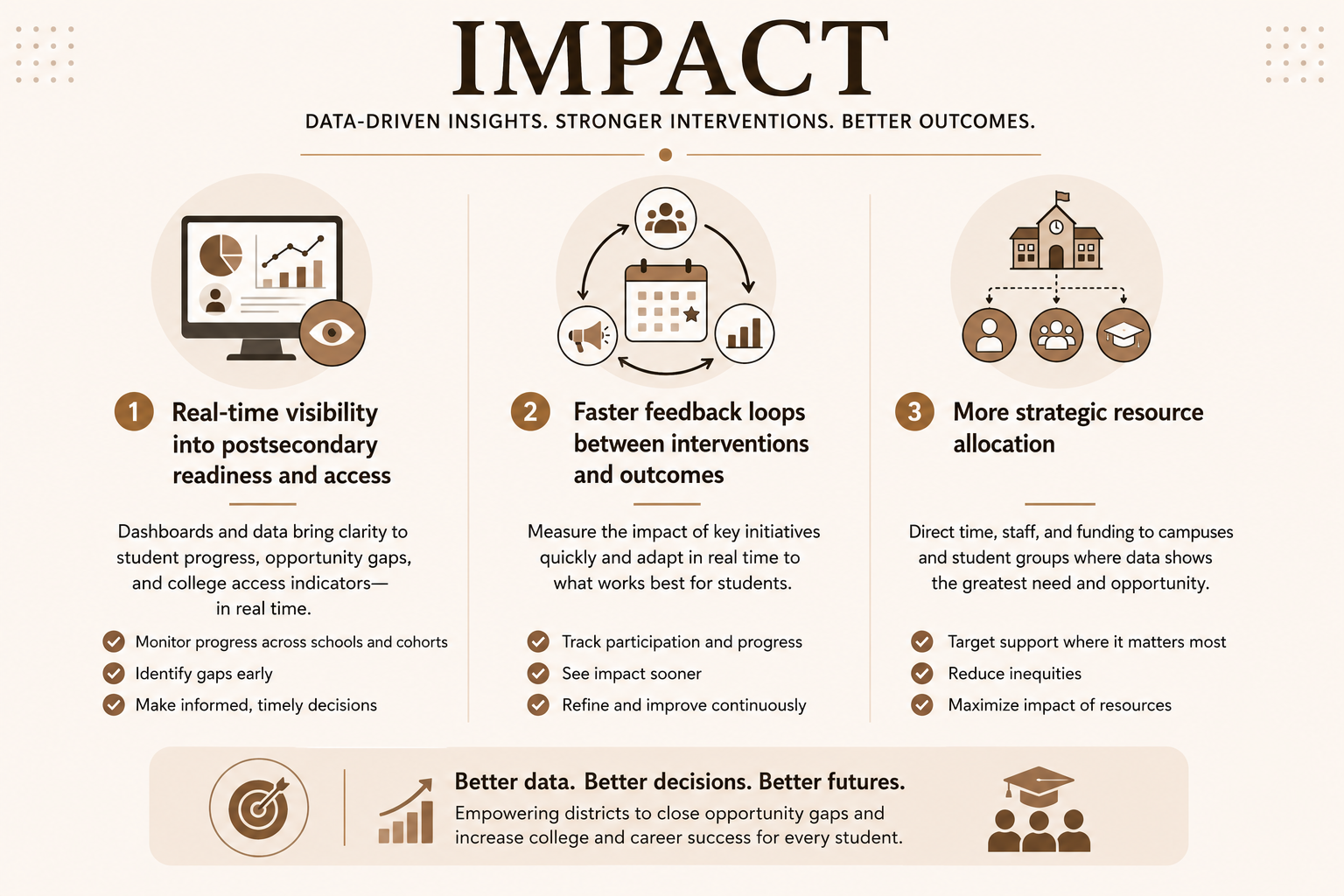
District leaders and counselling departments are increasingly held accountable for postsecondary outcomes: CCMR indicators, FAFSA completion rates, AP/IB participation and performance, college application, admission, and enrolment rates. Yet in many systems, this data takes months or years to arrive, spreads across multiple systems, and requires manual aggregation for annual reports.
The AI workflow
Automated data flows from SIS and state systems:
Academic, assessment, FAFSA, and postsecondary enrolment data flow automatically into a central reporting platform with no manual exports or uploads needed.
Standardised metrics and dashboards:
Key indicators like CCMR, FAFSA completion by cohort, AP registration gaps, and college application rates are standardised and made available via dashboards for counsellors, principals, and district leaders.
Trend detection and predictive insights:
AI models highlight trends and flag schools or subgroups at risk of missing targets, enabling earlier interventions. The CollegeFind.ai platform provides this kind of real-time visibility; for instance, read more about the team’s thinking on the CollegeFind.ai Medium blog.
“Seven use cases. Every one of them returns something the counselor can give to a student instead of to a spreadsheet.”
CollegeFind.ai Editorial Team, June 2026
For districts and schools exploring AI in counselling operations, the strategic question is not whether to automate everything, given that counselling is fundamentally human work. The question is which administrative and tracking tasks can safely move to machines so counsellors can spend more time on relationships, judgement, and advocacy?
These seven use cases offer a practical starting point. To explore how CollegeFind AI approaches this problem by including live demos and district case studies and connect with the team.
Explore ahead with CollegeFind AI —>