AI for High School College Counseling: The Complete Guide for Schools in 2026
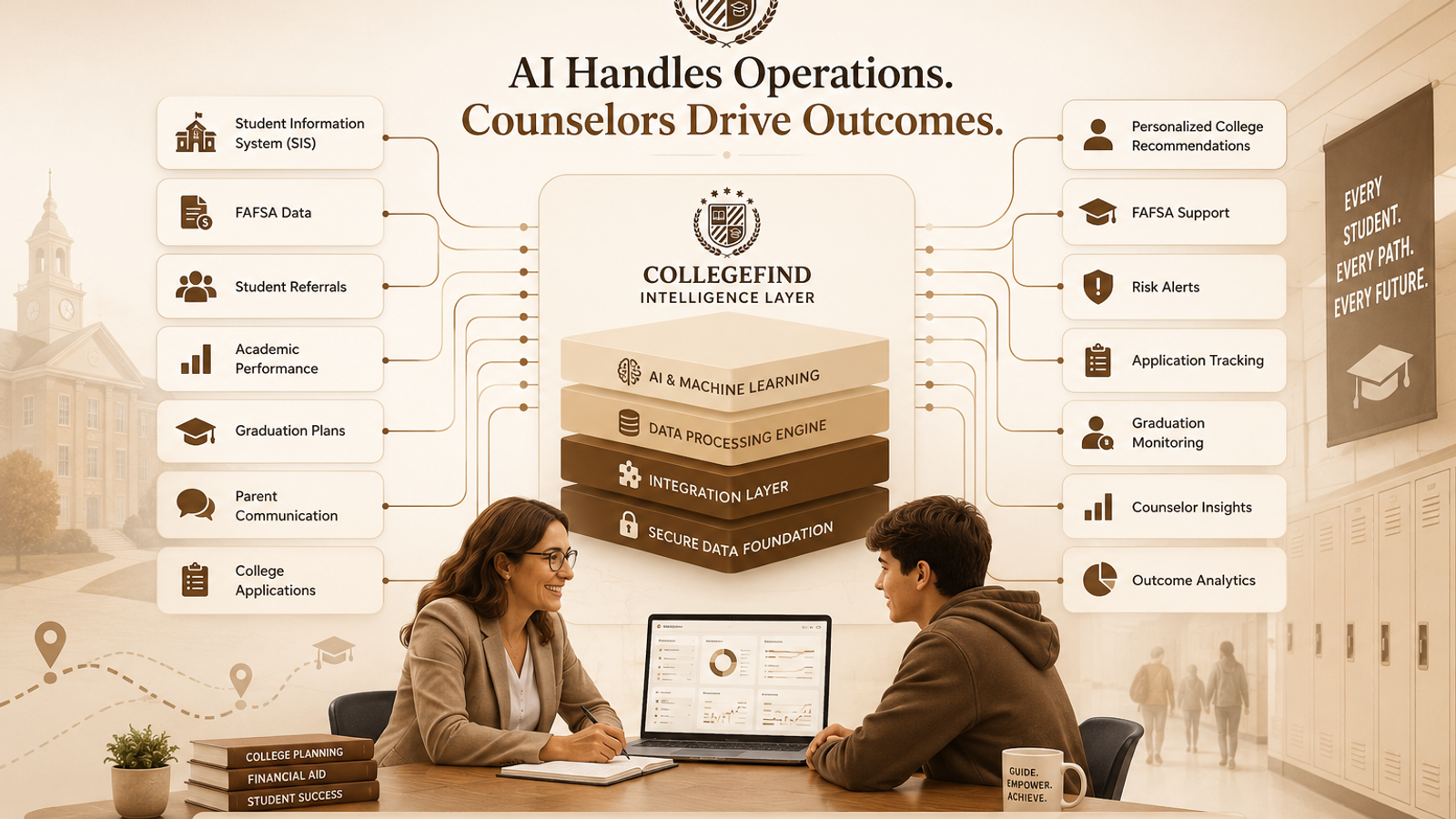
AI for High School Counselling: Giving Counsellors More Time for What Matters Most
The Problem Isn't that counsellors aren’t Doing Enough
Ask almost any school counselor what they wish they had more of, and the answer usually isn't new software.
It's time.
Time to sit down with a student who's unsure about college.
Time to help a family understand financial aid.
Time to follow up with the senior who missed an application deadline.
Time to reach the student who hasn't asked for help—but probably needs it.
The reality is that most counseling teams are already stretched thin.
A typical day can include college advising, FAFSA support, graduation planning, parent meetings, teacher referrals, scheduling issues, scholarship guidance, and crisis support.
And somehow, counselors are expected to make sure no student falls through the cracks.
The challenge isn't effort.
The challenge is capacity.
Why Capacity Has Become the Real Issue
The role of a school counselor has changed dramatically over the last decade.
Students today have more options than ever before.
That's a good thing.
But it also means they have more decisions to make.
A student exploring life after high school might be comparing:
- Four-year universities
- Community colleges
- Trade schools
- Apprenticeships
- Dual-enrollment opportunities
- Industry certifications
- Workforce pathways
At the same time, families are trying to understand financial aid, scholarships, FAFSA requirements, and the true cost of college.
None of these conversations are simple.
And they usually require multiple meetings.
That's not just a number.
It's the difference between having time to proactively reach out to students and constantly feeling like you're reacting to the next urgent task.
FAFSA Is a Good Example of What's Really Happening
Most educators know FAFSA completion matters.
What often gets overlooked is why some students complete it and others don't.
Very few students abandon the FAFSA because they don't care about college.
More often, they get stuck.
A parent can't find a document.
A student misses an email.
A family doesn't understand a question.
Someone intends to finish it later and simply never comes back.
According to the National College Attainment Network (NCAN), students who complete the FAFSA are significantly more likely to enroll in college than those who do not.
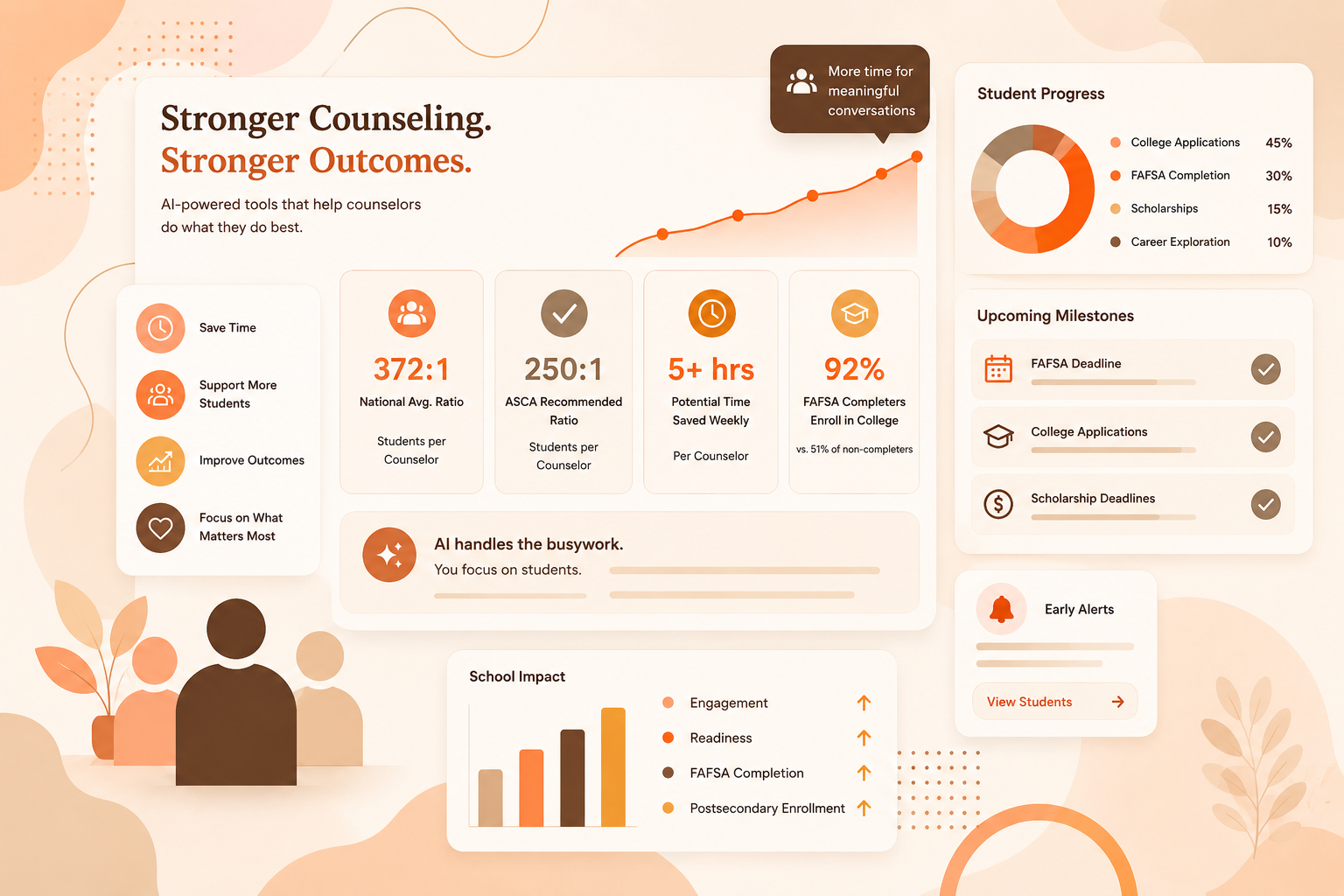
The image represents a modern student-centred counselling environment where technology is doing its job unobstructed in context to assist counsellors. The dashboard indicates how students are performing, when they’ve completed the FAFSA, when they’re ready for college and when they need early aid. The data visualisations are friendly and approachable, using muted colours and rounded design elements to show how AI can support schools with organisation, early identification of student needs and the automation of day-to-day labour. The more time counsellors have free from the paperwork and deadlines, the more time they have for meaningful meetings that help students chart their futures.
But successful FAFSA completion usually isn't the result of a reminder email.
It's the result of human follow-up.
Someone checking in.
Someone answering questions.
Someone notices a student needs help.
The challenge is that follow-up takes time.
And time is the one resource many counseling teams don't have enough of.
Where AI Fits In
When people hear "AI in education”, they often jump straight to a fear:
"Will AI replace counsellors?”
The reality is much less dramatic.
The schools seeing the most success with AI aren't using it to replace human support.
They're using it to remove the administrative work that hinders in the way of human support.
Think about the number of hours spent every week:
- Tracking deadlines
- Sending reminders
- Updating records
- Following up on missing forms
- Managing referrals
- Organizing notes
- Answering the same questions repeatedly
Those tasks matter.
But they're not the reason most people become counselors.
Most counselors enter the profession because they want to help students navigate important decisions.
The more time spent on paperwork, the less time available for people.
AI helps shift that balance.
What Schools Are Learning
The schools getting the most value from AI aren't looking for automation.
They're looking for capacity.
They're using technology to:
- Keep student information organized
- Track college and career readiness milestones
- Monitor FAFSA progress
- Improve communication with families
- Identify students who may need support earlier
- Give counselors better visibility into student needs
In other words, they're using AI to help counselors spend more time counseling.
Not less.
What AI Will Never Replace
Technology can help schools become more efficient.
It can help organize information.
It can automate reminders.
It can identify patterns.
What it can't do is replace trust.
Students still need adults who will listen when they're uncertain.
Families still need someone they can call when they have questions.
And counselors still play a role that no technology can replicate.
As educator Rita Pierson famously said:
"Every child deserves a champion—an adult who will never give up on them."
Technology can support that work.
But it will never replace it.
Why Schools Are Exploring Collegefind.ai
At Collegefind.ai, we believe the future of student support is not about replacing counsellors.
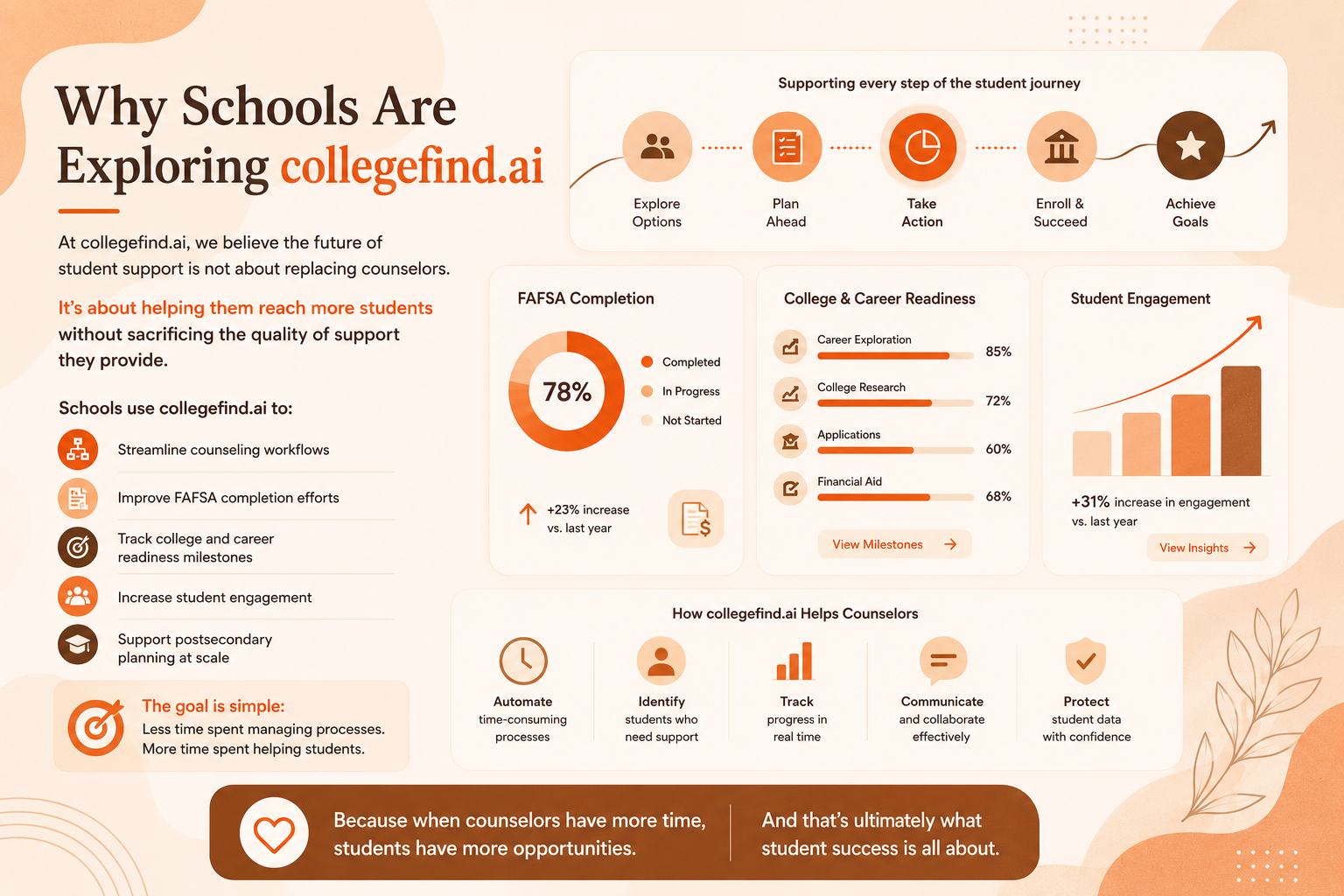
The image depict that how collegefind.ai helps colleges and universities optimise counselling procedures, enhance FAFSA completion, manage college readiness milestones and serve more students. The related path and progress indicators suggest the major aim of freeing up counsellors to spend more time with students and less time on administrative responsibilities.
It's about helping them reach more students without sacrificing the quality of support they provide.
Schools use CollegeFind.ai to:
- Streamline counseling workflows
- Improve FAFSA completion efforts
- Track college and career readiness milestones
- Increase student engagement
- Support postsecondary planning at scale
The goal is simple:
Less time spent managing processes.
More time spent helping students.
Because when counselors have more time, students have more opportunities.
And that's ultimately what student success means.
Frequently Asked Questions
Can AI replace school counselors?
No. AI can help automate administrative work, but it cannot replace the relationships, trust, mentorship, and guidance that counselors provide.
How can AI help counseling teams?
AI can support tasks such as FAFSA tracking, deadline reminders, communication, referral management, and student progress monitoring, giving counselors more time to work directly with students.
Does AI improve FAFSA completion?
AI can help schools identify students who may need support, automate reminders, and improve follow-up efforts, making it easier for counseling teams to keep students on track.
Why are schools choosing CollegeFind.ai?
Schools choose CollegeFind.ai because it helps counseling teams scale personalized support, reduce administrative burden, and improve visibility into student needs without losing the human connection that makes counseling effective.
Ready to Learn More?
See how CollegeFind.ai helps schools create more time for meaningful student support while improving college and career readiness outcomes.
Request a Demo Today→